Abstract
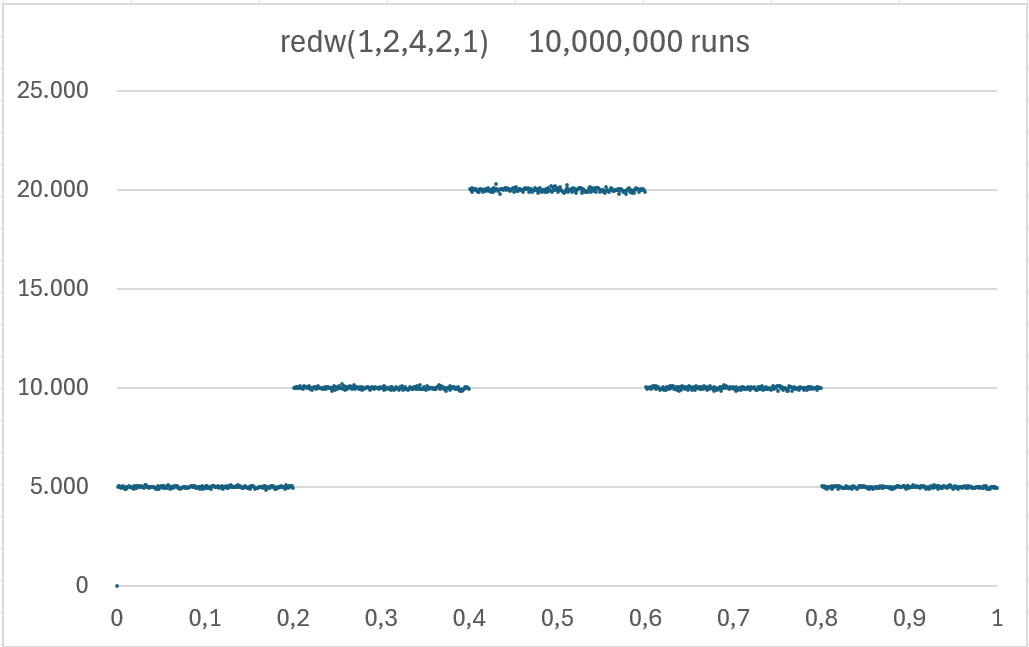
Suppose you want to simulate teachers who judge pupils. Some teachers do not dare to give extreme grades (assume they give grade 1 for 2% of all cases, grade 2 for 8%, grade 3 for 80%, grade 4 for 8% and grade 5 for 2%). The next teacher is too critical, his distribution is 40%, 30%, 20%, 10% and 0% for grades 1 till 5. Another one only gives grade 4 (60%) and grade 5 (40%). A last one finally offers sort of a “fair” normal distribution (10%, 20%, 40%, 20%, 10%). How do you produce these random numbers which are distributed as mentioned above? Take the following procedure redw() which creates random numbers with equidistant weights. This function would be called with
=INT(1+5*redw(10,20,40,20,10))
to simulate the “fair” teacher, for example.
Appendix – Redw Code
Please read my Disclaimer.
Function redw(ParamArray vWeights() As Variant) As Double
'Source (EN): https://www.sulprobil.de/redw_en/
'Source (DE): https://www.berndplumhoff.de/redw_de/
'(C) (P) by Bernd Plumhoff 09-Dec-2009 PB V0.50
'Produces random numbers with equidistant weights. Redw expects a vector of n random
'weights of type double and returns a random number of type double. This random
'number will lie in the given equidistant n-split-range of the [0,1)-interval with
'the given likelihood of weightings. Call Randomize before calling redw! Examples:
'a) redw(0,1,0,0,0,0,0,0,0,0) will return a random number d, 0.1 <= d < 0.2
'b) redw(2,1) will return a random number between 0 and 0.5 twice as
'   often as a random number between 0.5 and 1.
'c) redw(0,1,0) will return a random number d, 0.333333333333333 <= d < 0.666666666666666.
'd) redw(15.4,15.4,15.4,15.4,15.4,7.7,7.7,7.7,0,0) would return a random value between
'   0 and 0.8, first 5 deciles with double likelihood than decile 6-8.

Dim i As Long
Dim dw As Double
ReDim dwi(0 To UBound(vWeights) + 2) As Double

dw = 0#
dwi(0) = 0#
For i = 0 To UBound(vWeights)
  If vWeights(i) < 0# Then  'A negative weight is an error
    redw = CVErr(xlErrValue)
    Exit Function
  End If
  dw = dw + vWeights(i)     'Calculate sum of all weights
  dwi(i + 1) = dw           'Calculate sum of weights till i
Next i

redw = dw * Rnd

'i = UBound(vWeights) + 1 'i already equals UBound(vWeights) + 1, you may omit this statement.
Do While redw < dwi(i)
  i = i - 1
Loop

redw = (CDbl(i) + (redw - dwi(i)) / vWeights(i)) / (CDbl(UBound(vWeights) + 1))

End Function
Note: A comprehensive documentation of my Excel implementations can be found in Excel VBA A Collection.