Abstract
If your business fluctuates strongly seasonally, you can plan the vacation of your staff accordingly and consider hiring seasonal staff:
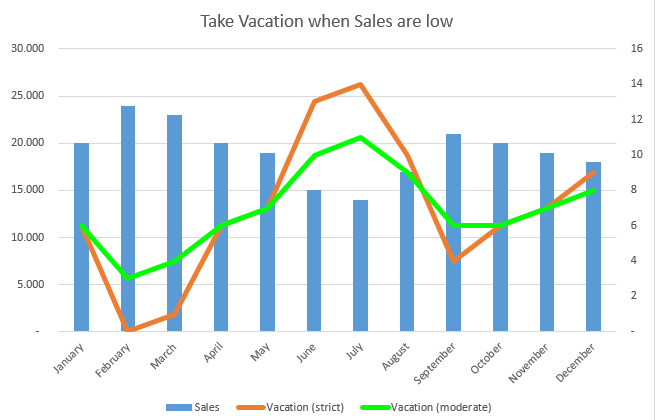
Note: Of course you cannot force anybody when to take a vacation and how many days are to be taken. These calculations are just meant to be suggestions of reasonable indicators.
Simple Example
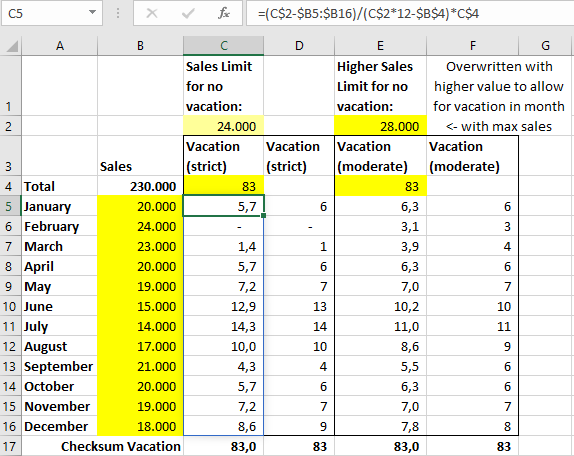
If you like to take the maximum sales values (here: 24,000) as a basis, applying zero vacations to it, and scale the vacation days linearly to the other sales values:
| Period | Sales | Vacation days (integer) |
|---|---|---|
| Total | 230,000 | 83 |
| January | 20,000 | 6 |
| February | 24,000 | - |
| March | 23,000 | 1 |
| April | 20,000 | 6 |
| May | 19,000 | 7 |
| June | 15,000 | 13 |
| July | 14,000 | 14 |
| August | 17,000 | 10 |
| September | 21,000 | 4 |
| October | 20,000 | 6 |
| November | 19,000 | 7 |
| December | 18,000 | 9 |
The formula in cell C5 which spills down to B16 is =($C$2-B5:B16)/($C$2*12-$B$4)*$C$4:
More Complex Example
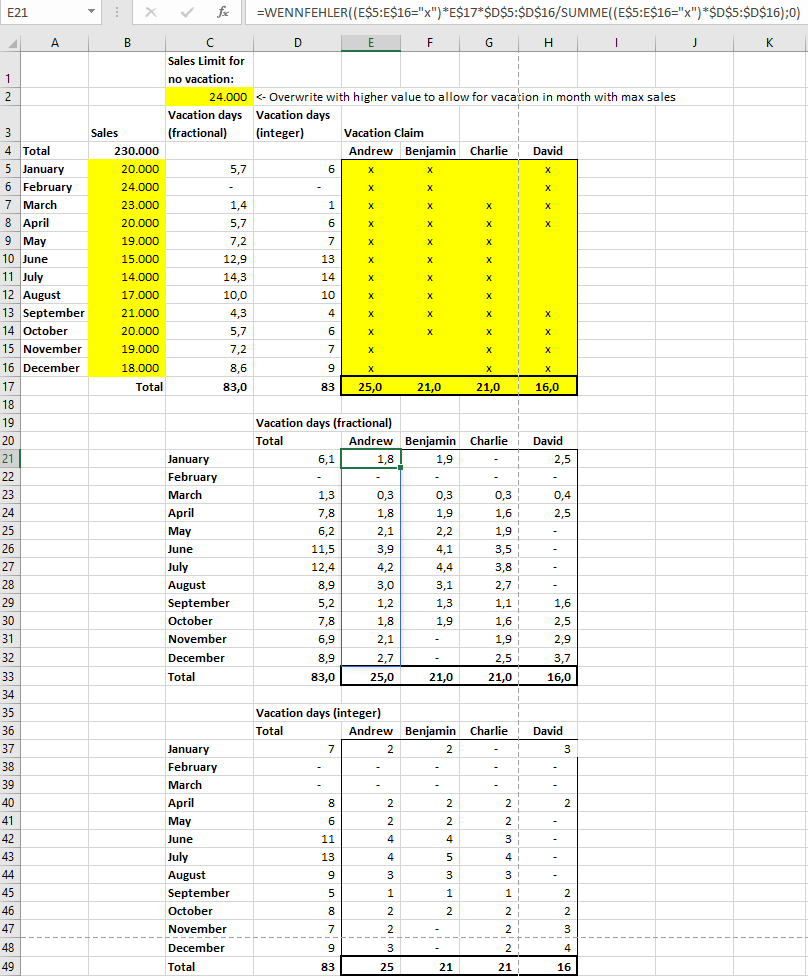
If you got employees who are not present at specified months:
(formula in cell E21 reads: =IFERROR((E$5:E$16=“x”)*E$17*$D$5:$D$16/SUM((E$5:E$16=“x”)*$D$5:$D$16),0)
Download
This program is using RoundToSum.
Please read my Disclaimer.
take_vacation_when_sales_are_low.xlsm [54 KB Excel file, open and use at your own risk]
Note: A comprehensive documentation of my Excel implementations can be found in Excel VBA A Collection.